

Kit & Gear
Choosing a Climbing Rope
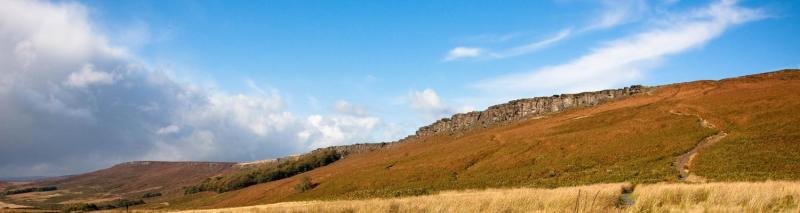
Up the road from our training centre at Bamford is Castleton. In Castleton, hidden 280ft beneath the imposing 11th-century ruins of Peveril Castle, is the even more impressive Peak Cavern.
The Devil's Arse, as it's known locally, is the largest natural cave entrance in Britain: some 60ft high, 100ft wide and 340ft long. Quite large, yes. But what has this to do with choosing a climbing rope, you may wonder?
Well, for around 500 years, until the early 20th century, Peak Cavern was home to the country's last remaining troglodytes (cave dwellers). Families built their homes in the cave entrance (the soot from their chimneys still marks the roof in places) and used this huge enclosed space to earn a living making rope to sell in the village, often to the local mining industry.
We don't use their ropes on our courses, and I'm not sure what the UIAA fall rating would be either, so let's crack on.
At the end of every rope in a climbing shop is a label, seemingly understood only by the initiated (the staff). Fear not! Choosing a rope can seem fiendishly complex, but it's simple as long as you ask the right question.
Climbing ropes are safe and actually work. Even cheap ones. But they are all made with a specific use in mind, so ask yourself: what will it be used for most of the time?
There are two types of rope you'll come across in climbing: dynamic (stretchy) and static (not stretchy). Use dynamic for climbing and static for rigging belays.
The rest of this article is about dynamic ropes, which range in thickness from around 7.1mm to 10mm. Thinner means lighter, but less durable, and can be so slick that belaying and handling are difficult. Thicker means tougher, but heavier and sometimes stiff, which can make belaying and knotting harder.
A good all-round length for climbing in the Peak is 60m. You can get away with shorter, especially on the gritstone edges, but the walk-ins are short so why worry about the extra weight?
Ropes also come 'dry treated', a treatment that helps stop a rope getting wet. Big deal, you may think. But a wet rope can lose as much as 30% of its strength, wet ropes can freeze, and they wear out faster from picking up grit and dirt. Dry treated ropes cost more, but can be worth it in the long run.
Single ropes
For the Peak District, a good first rope would be 60m long, between 9.5mm and 10mm thick and rated as a single rope (a '1' in a circle on the label). It will serve you well for grit routes that don't wander too much, sport climbing and the wall. A single rope also makes belaying easier, and you can use an assisted braking device like a GRIGRI.
Half ropes
Another popular choice, especially for Peak trad climbing, is a pair of half ropes (a '½' in a circle on the label). Again, 60m is a good length, and 8.5mm a good compromise between weight and durability. Half ropes are used in pairs and clipped into alternate pieces of protection.
They have several advantages: a shorter fall if your top piece of gear rips, less rope drag on wandering routes, full-length abseils when tied together, and some redundancy if one rope is damaged or cut. They are trickier to belay with, especially for beginners, and a bit of a faff for sport climbing or at the wall.
Twin ropes
The third type is the twin rope (two overlapping circles on the label). Twin ropes are used as a pair, with both strands clipped into each piece of protection. They're mainly used in alpine climbing, as they're light, offer redundancy and allow full-length abseils. Twin ropes are rarely used for general rock climbing in the UK.
Triple rated ropes
Manufacturers now make ropes rated as single, half and twin, in diameters as low as 8.5mm.
Remember our question from earlier? Ask it again. Yes, you can work a sport route on a super-skinny triple rated rope, but not for long. Use it for on-sights within your grade or the occasional hard redpoint.
Triple rated ropes really come into their own when multi-pitch climbing as a three on double ropes, for example for guides and instructors. The leader can bring up each second on one of the two ropes, as each is rated as a single rope.
Find out more
This article is an introduction to buying a rope, and there's much more to it than we can cover here. For the full story, read the BMC's excellent guide: rope markings explained.