

Bouldering
Bouldering in the Peak District for Beginners
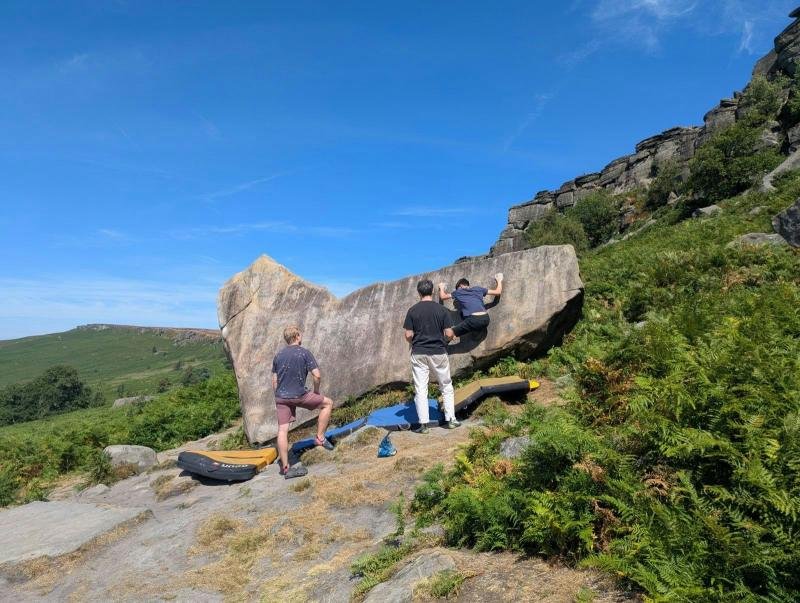
Bouldering is climbing in its simplest form: short climbs (called problems) on boulders and small rock faces, with no ropes or harnesses. All you need is a pair of climbing shoes, a chalk bag and a pad to land on. The Peak District has some of the best bouldering in the world, with problems for every level, so if you've been bouldering indoors it's the perfect place to take it outside.
The quickest way to get confident on real rock is a day with an instructor, with all the pads and kit provided:
What do I need?
- Climbing shoes: your indoor shoes are fine.
- Chalk and a chalk bag, plus an old toothbrush for cleaning holds.
- A bouldering mat (crash pad): essential outside. It cushions your landings and protects the ground at the base of the boulder.
- A spotter: a friend whose job is to guide your fall onto the pad and protect your head and back.
- Layers, food and water: some boulders are a short walk from the road, and gritstone gets chilly when the wind picks up.
Where can I hire a bouldering mat?
We don't rent out pads ourselves, but Alpkit in Hathersage, just down the road from us, rents bouldering mats by the day. Book ahead with the store, and bring photo ID (renters need to be 18 or over). If you then decide to buy one of their mats, they'll refund the rental cost.
If you join one of our bouldering courses, all the pads and equipment are provided.
Where to go bouldering in the Peak District
There are hundreds of venues, but these are friendly places for a first outdoor session:
- Burbage Valley: a huge number of easier problems on rough, grippy gritstone, close to the road, with lovely views.
- Stanage Plantation: the boulders below the most famous crag in the Peak, with something for everyone, though it gets busy on sunny weekends.
- Robin Hood's Stride and Cratcliffe: atmospheric boulders in the gentler countryside of the southern Peak.
A guidebook or app will help you find the easier problems. Start well within your indoor grade: outdoor problems often feel harder, and reading the rock (rather than following coloured holds) takes practice.
Look after the boulders
Gritstone is soft and can be damaged easily, and our crags are shared with walkers, farmers and wildlife. A few simple habits keep them in great shape:
- Don't climb on wet gritstone. It's weaker when wet and holds can snap off. Wait for it to dry.
- Brush off chalk and tick marks when you've finished.
- Wipe your shoes before you climb so you don't grind dirt into the rock.
- Keep pads and kit tidy, stay on paths and take all your litter home.
- Check for access restrictions, such as seasonal bird nesting closures. The BMC's Regional Access Database is the place to look.
Stay safe
Boulders can be higher than they look, and landings can be rocky or sloping. Place your pad carefully, move it as you climb, always use a spotter and never climb above anything you couldn't land on safely. Climb down or jump off in control rather than falling from the top.
Learn with us
Our beginner day covers spotting, pad placement, technique on real rock and crag etiquette, and includes free use of our bouldering wall afterwards. Once you're up and running, the improvers course takes you further: harder problems, reading sequences and getting more from every session.
Raining? Our bouldering wall at The Adventure Hub in Bamford has around 20 problems and a 35-degree training board, perfect for keeping strong until the rock dries.